Thursday, January 31, 2008

Ancient Life Remains Found in Mysterious Rocks


Claims that microbial life began on Earth billions of years ago have been given support from a French team which drilled into mysterious layers of spongy rock in Western Australia.
Researchers from the Institute for Global Physics in Paris used a technique called nanospectroscopy to pore over cores drilled from an enigmatic rock formation in the Pilbara region.
Palaeo-geologists from around the world have been lured to Pilbara, famous for rock layers in the shape of cones, waves and "egg carton" domes.
One school of thought holds that these layers comprise the fossilized remains of bacteria, called stromatolites, that seethed in shallow seas or lake water, which washed over the area when the Earth was young.
Others, though, dispute a microbial origin, and say the shapes were the result of chemical weathering, a reaction between the rock and sea water, or hydrothermal vents.
The French investigators, led by Kevin Lepot, drilled a deep core of rock from the Pilbara's Tubiana formation at Meentheena and took images of the sample to a resolution of 10 nanometers, or 10 billionths of a meter.They found minute crystals of aragonite, a calcite residue from dead micro-organisms.
Previous research have dated the Tubiana rocks to 2.72 billion years.
In 2006, Australian and Canadian researchers led by Abigail Allwood of Sydney's Macquarie University dated microfossils in rocks from Pilbara's Strelley Pool Chert formation at more than 3.4 billion years old, the earliest evidence so far of life on Earth.
Dating of early life on Earth could help determine whether life exists, or has existed, on Mars, the best bet for microbial life forms in other planets of the solar system.
Mars once had an atmosphere and was awash with water -- two ingredients that, with warmth, comprise the essentials for bacterial life.
The new study appears in the February issue of the journal Nature Geoscience, published by Britain's Nature group.
By AFP

Saturday, January 26, 2008

Only Species at Extremes Skip Sex


Want to produce a clone? If so, you would have the best chance if you were a rare, aquatic plant living in an undisturbed, geographically marginal habitat, according to a new study on asexual reproduction.
Since the combination of circumstances is so narrow, the findings suggest that sexual failure winds up being the key component for cloning success.
"I suggest that clonal reproduction is not a substitute for success, but merely prolongs the time to extinction when sex is absent," Jonathan Silvertown wrote in his paper, which has been accepted for publication in the International Journal of Plant Sciences.
Silvertown, a professor of ecology at the Open University in Milton Keynes, England, told Discovery News that both plants and animals can create natural clones. Certain sharks and lizards, for example, may reproduce asexually, as can microscopic organisms called rotifers. Corals, sponges and other "modular animals" can also break off into clones.
Plants, however, represent the vast majority of clones "because growth in plants takes place in a modular way, so modules, such as stems, twigs, shoots, and repeated units like that are half-way to cloning," he said.
In fact, the vast majority of plants can reproduce both sexually and asexually.
Silvertown, author of the book, "Demons in Eden: the Paradox of Plant Diversity," analyzed the ratio of genotypes per number of plants within 218 species among 74 plant families. He obtained the information from 248 prior studies covering 69,000 individual plants.
"[The ratio] tells you how many of the individuals sampled are genetically unique," he explained. "Unique ones are the product of sexual reproduction. If genotypes are fewer than the population numbers, there are some 'identical twins' and likely clones in the pack."
Based on the data, Silvertown came up with five characteristics that virtually all of the plant clones share. He believes most of these carry over to animal clones, too.
The first is that clones are more likely to be found among older populations, indicating clonal reproduction is limited by disturbance. Since clones do not vary, they usually all kick the bucket when their environment is altered, so existing clones tend to live in older, undisturbed populations.
The second is that, since asexual reproduction requires a means of dispersal, clones are more frequent in aquatic species. Water hyacinths are a good example of this sort of clone, since they are free-floating and easily multiply without sex.
The third and fourth determinations are that clones are more frequent in populations of rare, endangered and alien species. The absence of easy-to-find mates can drive individuals to clone themselves.Finally, clones appear to be more frequent at the edges of a species' geographical range, again because mating gets literally pushed to its limits under such conditions.
"Asexual individuals can be good colonizers and very successful in the short term, so these will increase," said Silvertown, who also forecasts these same clones will go extinct after around 50,000 years.
Spencer Barrett, a professor of evolutionary biology and Canada Research Chair at the University of Toronto, told Discovery News that he agrees with the findings of the research and is "not really surprised by them."
"The thing I like about this paper is that it draws attention to the need to understand functional interactions between clonal and sexual reproduction in plants," he said. "We don't actually know much about this."
Both Silvertown and Barrett are particularly concerned about inbreeding, which can occur in clone populations. In yet another paper, recently published in Science, Silvertown found that inbreeding can lead to higher extinction rates over a 60-year period.
The upshot is that sex beats cloning where long-term fitness, and even survival, is concerned.
"In theory, females that reproduce asexually should enjoy a twofold advantage in fitness over sexual females, yet sex remains the predominant mode of reproduction in virtually all [multicellular organisms]," Silvertown concluded.
Jennifer Viegas
http://dsc.discovery.com/news/2008/01

Giant Internal Waves Caught Breaking


A 900-mile-long string of scientific instruments across a stretch of the open ocean has revealed the first evidence of giant internal waves partially "breaking" inside the oceans.
Tide-generated internal waves up to 300 feet tall are thought to mix shallow and deep waters when they break -- and so play a role in climate-critical ocean currents. Despite their size, they have been very hard to find in the act of fully breaking.
"We know where the waves are generated but we really don't know where they break," said Matthew Alford of the University of Washington, Seattle Applied Physics Laboratory and School of Oceanography.
Like the surface waves that travel at the interface of water and air -- which have very different densities -- internal waves propagate deep down in the oceans where denser, colder and saltier deep waters meet warmer, fresher and less dense upper waters.
To find out where they break, Alford and his team ventured to French Frigate Shoals northwest of the Hawaiian Islands, where the twice-a-day tidal sloshing of water across the undersea ridge churns out internal waves that roll northwards.
They installed a series of moorings in the three-mile-deep water, each equipped with a robot that chugged up and down the cable every few hours to collect data on water temperature, salinity as well as speed and direction of the water flow.
The moorings were placed along what ocean models had predicted was a fairly straight and likely path for internal waves created by tidal flow squeezing over the ridge at French Frigate Shoals. The team also used a radar-gun-like method to detect and observe the waves along the line of the moorings from aboard the research vessel."This is the first effort to look in the ocean for the theoretical breakdown in the internal wave," said internal wave researcher John Toole of Woods Hole Oceanographic Institution, who was not a member of the expedition.
Once the data were in, they revealed the internal waves moving along north. But instead of fully breaking, the data showed the waves only "sloshed over" a bit, said Alford, conserving most of their energy.
"The rest is just rocketing off to parts unknown," said Alford. Perhaps they break closer to the Aleutians or even on the Oregon coast, he said. Their findings were published in the current issue of the journal Geophysical Research Letters.
Discovering where the tidally-induced internal waves break is especially important for accurately tracking how oceans move heat and energy around the planet. It's thought that internal waves play a big role in allowing cold, deep waters to well up to the surface in lower latitudes.
Those upwellings are part of a global heat conveyor belt known as the thermo-haline circulation which carries warmer saltier waters like the Gulf Stream poleward to cool and sink. Then the waters move along the bottom of the oceans to lower latitudes where the waters then rise -- if there are internal waves in the right places to mix things up and help push the cold waters upward.
"The real key is not only how much turbulence, but where the turbulence is," said Alford. His team's work is the first step in that deep-sea search.

Larry O'Hanlon,

Monday, January 21, 2008

Thick, Old Arctic Ice Nearly Gone


A new study using satellite measurements of Arctic sea ice have revealed that thinner ice that's only two or three years old now accounts for 58 percent of the ice cover -- up from 35 percent in the mid-1980s.
Meanwhile, ice older than nine years had all but disappeared by 2007.
The extinction of the older, thicker ice is effectively melting away the Arctic Ocean's hedge against complete summer meltdowns, say researchers.
"The thinning is consistent with long-term warming," said ice researcher James Maslanik of the University of Colorado in Boulder.
Maslanik is the lead author of a paper reporting the thinning ice published in the latest issue of the journal Geophysical Research Letters.
The key difference in the new study from those done in the past is that the researchers were able, for the first time, to distinguish and measure different thicknesses of perennial ice -- that's ice which survives summer melts to grow thicker for multiple winters.
The result is that the researchers can better calculate the sea ice volume in addition to how much area the sea ice is covering.
Both are critical numbers for deciphering how the Arctic Ocean is responding to global warming.
"In our study, in the maps, there are a couple of places where the ice thickness has increased," said Maslanik, "but it doesn't balance out with the losses."The thinner ice that's now dominating the Arctic is more vulnerable to ridging -- the crumpling into ridged rafts of ice -- or melting. Either way you get more open water which can absorb summer sunlight and warm up the Arctic even further.
The key to the new sea ice measurements is data from the laser altimeter onboard NASA's Ice, Cloud and Elevation Satellite (ICE-Sat). Using the altimeter data to measure the different heights of ice floating above the water, the researchers could distinguish between older, thicker perennial ice and younger, thinner perennial ice.
They then applied the new information to almost three decades of data from satellite imagery and drifting buoys, which had been used to estimate ice age. The result was a record of differently-aged perennial ice volumes going back to the early 1980s.
"They had a remarkably high correlation of age and ICE-Sat observation," commented ice researcher Ron Lindsay of the University of Washington in Seattle.
Even better, the changes Maslanik's team sees over the decades seem to mesh with models over the same period, Lindsay told Discovery News.

By Larry O'Hanlon

Saturday, January 19, 2008

Monday, January 14, 2008

Go on a journey from S. America

http://es.youtube.com/watch?v=EuODA7jxvok

Deep Sea Vents: Hot, Wet, Weird


Thirty years ago, scientists exploring the depths of the ocean came across jets of hot water, spewing from the sea floor, which hauled up flecks of gold and other minerals from Earth's interior and nurtured weird, resilient microbial life forms.
In a paper issued on Wednesday, marine seismologists looking at a site in the East Pacific say they have gained insights into how this unique plumbing system of hydrothermal vents works.
The jets are found thousands of feet below the surface on the mid-ocean ridges -- geologically active "mountain ranges" -- formed from mighty tectonic plates that push into each other and form spines along the ocean floor.
Until now, the main hypothesis about hydrothermal vents has been that gigantic pressure forces seawater through large faults along the flanks of the ridge.
The water, the theory goes, is then heated by coming into proximity with volcanic rock before re-emerging at the middle of the ridges, where the vents are usually clustered.
But in the first detailed investigation into vent circulation, a team led by Maya Tolstoy of Columbia University's Earth Observatory in New York has come up with a different picture.
They placed seismometers over a 1.54-square-mile area of the East Pacific Rise, about 500 miles southwest of Acapulco, that has been under study for the past 15 years.
The sensors monitored tiny earthquakes that happen 8,125 feet below the surface. Around 7,000 of these brief, shallow quakes were recorded in 2003 and 2004 alone.
The tremors also built up an image of how the water circulates, because the quakes were intriguingly clustered around where the cold water entered the rock.The map drawn by Tolstoy's team shows a down-flow pipe that descends about 2,275 feet into the ridge, then fans out for about 650 feet.
The water then plunges down another 1,950 feet until it arrives just above a bulge of magma. There, the water is heated and disgorged along the ridge through a dozen vents about 1.2 miles north of the entrance pipe.
Tolstoy's team contends that what appear to be tiny quakes are caused by the physical stress of cold water passing through hot rocks.
And, contrary to the prevailing hypothesis, they believe the water travels not through large faults but through systems of tiny cracks, and at a much higher rate of turnover than previously thought.
The paper, published by the British journal Nature, adds critical knowledge about seafloor currents and the nutrient flows that feed them. It also furthers understanding about the mechanics of heat transfer from Earth's crust to the seafloor.
Hydrothermal vents are sometimes called "black smokers" for the bilious clouds of material that emits from their chimneys.
by AFP

Friday, January 11, 2008

Earth Sciences


The year was 1990. George H.W. Bush was in the White House, coalition forces had declared war on Iraq, and Michael Bolton was at the top of the pop charts … Pretty grim, huh? Thank God for skateboarding. It was this very same year that a young pro skater from Upland, California named Chris Miller founded a company called Planet Earth. Along with World Industries, H-Street, New Deal, and Birdhouse, Planet Earth was one of the original skater-owned brands emerging at the time in response to what they saw as a lack of creativity in the industry. It was a sign—the skaters themselves were standing up to take control of their own destiny.
Seventeen years later, Planet Earth has become a powerful, culture-inspired and rider-designed apparel flagship of a distribution powerhouse called Earth Products that now extends beyond the realm of skateboarding into surfing and snowboarding. The seminal footwear brand and ground-breaking, fashion-forward outerwear label (Adio and Holden, respectively) have also been added to the Earth Products roster. A sale to K2 Inc. in 1997 provided the influx of capital and other resources needed for Planet Earth to grow, mature, and truly step into the future. And as founder and chief creative officer, Miller remains the captain of this vessel, playing a crucial part in the company’s identity and direction on all levels.


Prairie Grass: Fuel of the Future?


New research shows that prairie grasses grown using only moderate amounts of fertilizer on marginal land can produce significant amounts of ethanol.
The five-year study of switch grass done by the University of Nebraska and the USDA's Agricultural Research Service was published this week by the National Academy of Sciences.
Researcher Ken Vogel said he estimates that an acre of switch grass would produce an average of 300 gallons of ethanol based on the study of grass grown on marginal land on farms in Nebraska, South Dakota and North Dakota.
An acre of corn grown in those same states produces about 350 gallons of ethanol on average.
Renewable Fuels Association spokesman Matt Hartwig said this latest study adds to the evidence supporting the development of cellulosic ethanol.
"It underscores that cellulosic ethanol production is not only feasible, it is essential," said Hartwig, whose group represents ethanol producers.
Nebraska Ethanol Board Projects Manager Steve Sorum said the industry is excited about the prospects for cellulosic ethanol because the feedstocks for it, such as switch grass, are cheaper to grow. Plus some of the byproducts created in the process can be burned to generate electricity.
Sorum said the key will be developing an economic way to break down the cell walls of cellulose-based fuel sources.Hartwig said there is general agreement that 15 billion gallons a year is about the most ethanol that can be produced from grain with current technology without hurting grain markets. So he said it's important to develop other sources for the renewable fuel.
Vogel said comparing the amount of ethanol produced by corn with the amount that could be produced by switch grass is a bit unfair because the method of converting switch grass to fuel is still being perfected.
Last year, the Department of Energy announced plans to invest $385 million in six ethanol refineries across the country to jump-start ethanol production from cellulose-based sources, a process that has not yet been proven commercially viable.
But Vogel and the other researchers did develop an estimate of how much energy switch grass would produce based on current conversion rates. Switch grass produces more than five times as much energy than the energy that's consumed by growing the crop and converting it to ethanol, according to the report.
Vogel said this switch grass research is the most extensive to date. Vogel is a U.S. Department of Agriculture geneticist and a University of Nebraska-Lincoln professor.
Josh Funk, Asssociated Press

Saturday, January 5, 2008

Shifting Layers Over Arctic Blamed for Ice Melt


The dramatic loss of the Arctic ice cap may have been triggered by disruption to the thermal layers of atmosphere stacked over Earth's far north, according to Swedish research to be published Thursday.
The study, published in Nature, offers a new explanation for the rise in the Arctic's surface temperature, which over the past century has been nearly two degrees Celsius (3.6 Fahrenheit), or twice the global average.
Until now, the big suspect in "Arctic amplification" has been reflectivity of sunlight.
When the Sun's rays hit snow or ice, most of that solar energy bounces back into space -- but as those melting surfaces give way to dark-blue sea, the heat is absorbed instead.
This self-reinforcing process, called a feedback, is an established factor in accelerating warming in snow and ice.
But Stockholm University scientists led by Rune Graversen believe a possibly bigger cause for Arctic warming could be changes in heat transport in the middle of the troposphere, an atmospheric band that extends 10 kilometers (seven miles) above Earth's surface.
In polar regions, the layers of relative heat above the surface are usually stable. But Graversen says that over the last two decades or so there have been changes in Arctic atmospheric circulation which have brought in heat and moisture.
The moisture is particularly important, as it helps form persistent low cloud over the Arctic.
Moisture-laden clouds at this altitude tend to absorb heat from the Sun, thus bringing a warming effect close to the surface. In contrast, high-altitude clouds, which mainly comprise icy crystals, reflect heat back into space, and thus cool the surface.
The circulatory shifts have an especially big impact in summer, says Graversen.
In 2007, summer sea ice in the Arctic shrank to about four million square kilometers (2.4 million square miles), a 23 percent decrease from the previous record low of 5.3 million square kilometers in 2005.
A second study, also in Nature, meanwhile, shows that the capacity of vegetation to absorb carbon dioxide (CO2) appears to be ebbing, with potentially serious consequences for global warming.
Currently, about 50 percent of all the CO2 produced by burning fossil fuels is soaked up -- "sequestered" -- by land masses, mainly through forests, and by oceans.

Marlowe Hood, AFP

Friday, January 4, 2008

Eco Fashion Could Boost U.S. Farmers


In a workshop in the city's Mission District, Ally Beran's team of fashion designers is sprawled out over buttons and spools of thread, hoping to stem global warming by stitching new outfits from thrift store finds.
A brown lace applique from a scrap bin could make last year's castoff cashmere pop, Beran muses. Or, she reckons, swatches from a tattered leather jacket could double as chic epaulettes on a high-end used sweater. Designers of so-called sustainable fashion are not only dominating New York catwalks and urban boutique racks this winter, many also are providing farmers with new markets for their crops.
As with the movement for locally harvested food, ecofashion's devotees seek to lower their toll on the earth by buying clothes made of recycled materials and sustainably harvested, homegrown fibers.
This year, American Apparel and yoga-gear retailer prAna will start selling shirts spun with cotton grown in California's Central Valley and sewn just a few hours away, in Southern California, to avoid burning fossil fuels in transporting the materials.
Beran's creations, marketed under the label William Good -- an anagram of the company's business partner, thrift store giant Goodwill Industries -- are only sold online and in stores near San Francisco, also to reduce their carbon footprint.
Last summer, New York's Rag & Bone hired supermodel Shalom Harlow as the face for its line of filmy "carbon free" T-shirts, which were manufactured domestically in a process that required no greenhouse gas emissions.
For farmer Frank Williams, the new interest in locally grown, organic cotton has meant he's had to learn how to talk about threadcount and women's skirt lengths with the ecologically minded crowd that tours his fields near Fresno.
"These fibers are among the best organic in the world," Williams said as he led a group of fashion executives from China, Sweden and New York through rows of billowy cotton. "With the right diameter, length and strength you can really spin the finest yarns that you want."
Farmers in the United States grow a small portion of the organic cotton used by the apparel industry, which still sources most of its fibers overseas in countries like Turkey where labor and production costs are cheaper. The market is clearly booming, however: The nonprofit Organic Exchange predicts that sales of organic cotton fiber will reach $226 million by 2009, up from about $19 million in 2004.
As more companies seek to build a greener supply chain, American farmers are hoping that will translate into more demand for domestic crops.
Garance Burke, Associated Press

Thursday, January 3, 2008

Mars Asteroid Stirs Concern for Earth


It's been 100 years since a sizeable space rock smacked into Earth, leveling more than 1,200 square miles of trees in a Siberian forest. But a visceral reminder of just how much devastation an asteroid impact can have may be just around the corner.
Astronomers are keeping a close watch on a 160-foot wide asteroid designated 2007 WD5, which on Wednesday had a one in 20 chance of striking Mars on Jan. 30. Of course there are no cities or ecologies to worry about, and the prospect of Mother Nature boring a hole into the Martian terrain actually has scientists quite excited.
Scientists are on a quest to determine if Mars ever had habitats suitable for life and ultimately hope to learn if life ever evolved anywhere beyond Earth.
Three spacecraft are in orbit around Mars, including two equipped with sensors to scope out minerals. NASA has two rovers on the planet's surface as well, and a third lander slated to arrive in May, but the asteroid, if it hits at all, will leave its mark beyond the robots' range.
It would be quite another story if 2007 WD5 were heading toward Earth, as a similarly sized object did in 1908. What is believed to be a fragment from a comet plowed into the planet's atmosphere on June 30 that year and exploded over central Siberia with the force of a large nuclear bomb.
Fortunately, the region was unpopulated.
"Something of this size could take out a fairly large metropolitan area," said Donald Yeomans, a planetary scientist at NASA's Jet Propulsion Laboratory in Pasadena, Calif., who manages the agency's Near-Earth Objects program.

Irene Klotz, Discovery News

Captain Kidd's Ship Located Off Dominican Island


Dec. 14, 2007 -- A U.S. underwater archaeology team announced Thursday it has likely discovered the shattered remnants of a ship once captained by the notorious buccaneer William Kidd off a tiny Dominican Republic island.
The barnacled cannons and anchors found stacked beneath just 10 feet of crystalline coastal waters off Catalina Island are believed to be the wreckage of the Quedagh Merchant, a ship abandoned by the Scottish privateer in 1699, Indiana University researchers say.
"When I first looked down and saw it, I couldn't believe everybody missed it for 300 years," said Charles Beeker, a scuba-diving archaeologist who teaches at Indiana University. "I've been on thousands of wrecks and this is one of the first where it's been untouched by looters."
Beeker said the wreckage has been aggressively sought by treasure hunters, including a group with a permit from the Dominican government to scour Catalina for remnants of the ship, which historians believe was scavenged of treasure and burned shortly after Kidd abandoned it.
The Dominican government has licensed the U.S. university to study the wreckage and convert the sea floor where the cannons and anchors are marooned into an underwater preserve, where it will be accessible to divers and snorkelers.
"We believe this is a living museum," said Beeker, who has previously helped the Dominican government open underwater parks that feature cannons, jar fragments and other items recovered from early 18th-century shipwrecks. "The treasure in this case is the wreck itself."
The scattered cannons and anchors, partially hidden by swirling sand, were first spotted by a local man who reported his discovery to the Dominican government, according to Francis Soto, director of the National Office of Subaquatic Heritage and Culture.

David McFadden, Associated Press

Wednesday, January 2, 2008

Blue Planet (IMAX) [HD DVD] (1993)


The IMAX film Blue Planet offers an eloquent reminder--and a cautionary warning--that the planet Earth is a delicate living organism, constantly reshaped and rejuvenated by the awesome forces of nature. The film targets a grade-school audience but will prove informative to anyone fascinated by our home planet's evolution. Hurricanes, glaciers, volcanoes, thunderstorms, asteroid impacts, undersea furnace vents, and earthquakes are all explored as a system of interconnected forces that ensure the planet's survival. The difference between this and other nature films is that the Earth's delicacy is emphasized by stunning views from space, filmed in the IMAX format by NASA astronauts in orbit 200 miles above the Earth's surface. With astonishing clarity, this orbital perspective supports the film's ultimate purpose: to reveal the awesome beauty of the Earth, and to emphasize that we, the custodians of this miraculous gift, are also the greatest threat to the planet's delicate health. Proof of man's destructive influence offers a sobering reminder that our responsibility toward nature is perpetual, essential, and routinely abused.


Blue Planet combines state-of-the-art sound and image, principally directed by Ben Burtt, the Oscar-winning sound designer whose credits include the original Star Wars trilogy. No home-theater system could do full justice to the film's technical achievement, but the sights and sounds of Blue Planet are awesome nonetheless, and it's impossible to overstate the importance of the film's message and its hopeful emphasis on the potentially wondrous future of our one and only home. --Jeff Shannon


Product Description

From the unique vantage point of 200 miles above Earth's surface, we see how natural forces - volcanoes, earthquakes and hurricanes - affect our world, and how a powerful new force - humankind - has begun to alter the face of the planet. From Amazon rain forests to Serengeti grasslands, Blue Planet inspires a new appreciation of life on Earth, our only home.

Living Landscapes: The World's Most Beautiful Places [HD DVD]


Review"You'll be hard-pressed to find a single shot in 'The Most Beautiful Places in the World' that doesn't tickle the eye. I was particularly impressed with the cleanliness of the source -- it's crystal clear, with excellent blacks and very natural contrast. Colors are vibrant, yet very clean -- and they're refreshingly free from oversaturation. Detail is often exquisite, and the sense of depth is often akin to looking out of a freshly-scrubbed window." --Reviewed by Peter M. Bracke_Tuesday, June 12, 2007 About the DirectorAward winning Producer/Director, Michael Heumann, of dozens of internationally distributed video and television programs for Discovery Channel, Reader's Digest, and Rand McNally.

National Geographic's Strange Days on Planet Earth (2005)


This 2-DVD series powerfully shows how mankind is connected to nature and how far away events relate to one another. The program's stories spans 9 countries - USA, Uganda, Trinidad & Tobago, Nigeria, Jamaica, St.Lucia, Australia, Canada, and Venezuela with vignettes on several others. Four sections cover invasive species, climate change, predators, and rivers /ocean. In every section there is a discussion on how the action of man affects a place, and how that in turn affects us. One story talks about how changes in the atmosphere cause increased dust to blow from the African Sahara desert, which causes asthma in children and reef degradation far away - in the Caribbean. Another story talks about how very low levels of pesticides causes sex changes in frogs - which if taken to the logical conclusion, one might wonder how this affects human sexuality. Some of the most haunting images come from a man made lake that destroyed a rainforest in Venezuela due to the construction of a hydroelectric dam. After watching this, I suggest stepping back from the actual stories and consider how the theory applies to our current culture today. I have seen alot of nature DVDs and traveled extensively around the world for many months at a time, this is easily one of my favorites to explain the current situation of the world. It should be handed out for free. If you enjoy this you might be interested in these DVDs: NOVA - World in the Balance (Pollution from China reaching the US), NG Guns, Germs, & Steel, Shape of Life, BBC Blue Planet, Charcoal People(!!), Sacred Planet, Commanding Heights, Life & Debt, and Zapatista. The Shape of Life 4-DVD set also has an interesting story on invasive species too - regarding the New Zealand Flatworm destroying farmland in Scotland by eating worms. Power of the small...

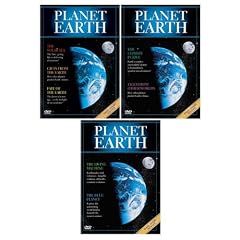
Planet Earth: The Complete Series, Vol. 1 - 3 (1986)


Since there is no information about this boxed set on the Amazon web site, I clicked on Internet Movie Database and searched the title. I came up with a 2006 David Attenborough production. This isn't it. I have watched only the section on climate and noticed how old it looked. Toward the end came a comment, "in the 90's scientists hope to find out..." As far as I can tell, this series was made in the 1980's. Despite its age, I will certainly use the climate part in my college biology course. It is a fair treatment that emphasizes science.


By
John H. Wahlert


Upon further inspection of this title, the other reviewer has it right. This program was a 7-part series which first aired on PBS in the United States during the spring of 1986. I watched it at the time and it is very good, although now the scientific facts might be a bit outdated. It's an interesting show nonetheless. Glad to see that they released it on DVD format...


By
A. de Lachica "Charybdis" (TX)


Beware: Planet Earth-The Complete Series . . . is NOT . . Planet Earth-The Complete BBC Series. In my enthusiasm for a $30 Planet Earth 'Complete Series' set I overlooked this not-so-obvious difference and feel burned. My 1986 series looks and feels very dated tho I'm sure it was very fine for its time. In it the pacing is rushed, they have funny haircuts, primitive computers and talk about Skylab.


By
D. M. Tilley

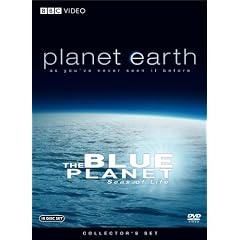
Planet Earth & The Blue Planet Seas of Life (Special Collector's Edition) (2007)


BBC natural history producer Alastair Fothergill spent the last ten years producing two of the most stunningly beautiful series ever created, The Blue Planet: Seas of Life and Planet Earth. For the first time, these must-own programs will be offered together in special collector's gift set. Winner of two Emmy(R) Awards (Outstanding Cinematography - Non-Fiction and Outstanding Music Composition for George Fenton's score), The Blue Planet: Seas of Life is the definitive exploration of the marine world, chronicling the mysteries of the deep, coastline populations, sea mammals, tidal and climatic influences, and the complete biological system that relies on and revolves around the world's oceans. Planet Earth does for the entire world what The Blue Planet: Seas of Life did for the oceans. Using high definition photography and revolutionary ultra-high speed cameras, this is the ultimate portrait of our planet. This truly breathtaking television experience captures rare action, impossible locations and intimate moments with our planet's best-loved, wildest and most elusive creatures.

Planet Earth - The Complete BBC Series [HD DVD]


As of its release in early 2007, Planet Earth is quite simply the greatest nature/wildlife series ever produced. Following the similarly monumental achievement of The Blue Planet: Seas of Life, this astonishing 11-part BBC series is brilliantly narrated by Sir David Attenborough and sensibly organized so that each 50-minute episode covers a specific geographical region and/or wildlife habitat (mountains, caves, deserts, shallow seas, seasonal forests, etc.) until the entire planet has been magnificently represented by the most astonishing sights and sounds you'll ever experience from the comforts of home. The premiere episode, "From Pole to Pole," serves as a primer for things to come, placing the entire series in proper context and giving a general overview of what to expect from each individual episode. Without being overtly political, the series maintains a consistent and subtle emphasis on the urgent need for ongoing conservation, best illustrated by the plight of polar bears whose very behavior is changing (to accommodate life-threatening changes in their fast-melting habitat) in the wake of global warming--a phenomenon that this series appropriately presents as scientific fact. With this harsh reality as subtext, the series proceeds to accentuate the positive, delivering a seemingly endless variety of natural wonders, from the spectacular mating displays of New Guinea's various birds of paradise to a rare encounter with Siberia's nearly-extinct Amur Leopards, of which only 30 remain in the wild.
That's just a hint of the marvels on display. Accompanied by majestic orchestral scores by George Fenton, every episode is packed with images so beautiful or so forcefully impressive (and so perfectly photographed by the BBC's tenacious high-definition camera crews) that you'll be rendered speechless by the splendor of it all. You'll see a seal struggling to out-maneuver a Great White Shark; swimming macaques in the Ganges delta; massive flocks of snow geese numbering in the hundreds of thousands; an awesome night-vision sequence of lions attacking an elephant; the Colugo (or "flying lemur"--not really a lemur!) of the Philippines; a hunting alliance of fish and snakes on Indonesia's magnificent coral reef; the bioluminescent "vampire squid" of the deep oceans... these are just a few of countless highlights, masterfully filmed from every conceivable angle, with frequent use of super-slow-motion and amazing motion-controlled time-lapse cinematography, and narrated by Attenborough with his trademark combination of observational wit and informative authority. The result is a hugely entertaining series that doesn't flinch from the predatory realities of nature (death is a constant presence, without being off-putting).
At a time when the multiple threats of global warming should be obvious to all, let's give Sir David the last word, from the closing of Planet Earth's final episode: "We can now destroy or we can cherish--the choice is ours." --Jeff Shannon
Product Description With an unprecedented production budget of $25 million, and from the makers of Blue Planet: Seas of Life, comes the epic story of life on Earth. Five years in production, over 2,000 days in the field, using 40 cameramen filming across 200 locations, shot entirely in high definition, this is the ultimate portrait of our planet. A stunning television experience that captures rare action, impossible locations and intimate moments with our planet's best-loved, wildest and most elusive creatures. From the highest mountains to the deepest rivers, this blockbuster series takes you on an unforgettable journey through the daily struggle for survival in Earth's most extreme habitats. Planet Earth takes you to places you have never seen before, to experience sights and sounds you may never experience anywhere else.

Tuesday, January 1, 2008

Planet Earth The Complete BBC Series David Attenborough (DVD 2007)


As of its release in early 2007, Planet Earth is quite simply the greatest nature/wildlife series ever produced. Following the similarly monumental achievement of The Blue Planet: Seas of Life, this astonishing 11-part BBC series is brilliantly narrated by Sir David Attenborough and sensibly organized so that each 50-minute episode covers a specific geographical region and/or wildlife habitat (mountains, caves, deserts, shallow seas, seasonal forests, etc.) until the entire planet has been magnificently represented by the most astonishing sights and sounds you'll ever experience from the comforts of home. The premiere episode, "From Pole to Pole," serves as a primer for things to come, placing the entire series in proper context and giving a general overview of what to expect from each individual episode. Without being overtly political, the series maintains a consistent and subtle emphasis on the urgent need for ongoing conservation, best illustrated by the plight of polar bears whose very behavior is changing (to accommodate life-threatening changes in their fast-melting habitat) in the wake of global warming--a phenomenon that this series appropriately presents as scientific fact. With this harsh reality as subtext, the series proceeds to accentuate the positive, delivering a seemingly endless variety of natural wonders, from the spectacular mating displays of New Guinea's various birds of paradise to a rare encounter with Siberia's nearly-extinct Amur Leopards, of which only 30 remain in the wild.
That's just a hint of the marvels on display. Accompanied by majestic orchestral scores by George Fenton, every episode is packed with images so beautiful or so forcefully impressive (and so perfectly photographed by the BBC's tenacious high-definition camera crews) that you'll be rendered speechless by the splendor of it all. You'll see a seal struggling to out-maneuver a Great White Shark; swimming macaques in the Ganges delta; massive flocks of snow geese numbering in the hundreds of thousands; an awesome night-vision sequence of lions attacking an elephant; the Colugo (or "flying lemur"--not really a lemur!) of the Philippines; a hunting alliance of fish and snakes on Indonesia's magnificent coral reef; the bioluminescent "vampire squid" of the deep oceans... these are just a few of countless highlights, masterfully filmed from every conceivable angle, with frequent use of super-slow-motion and amazing motion-controlled time-lapse cinematography, and narrated by Attenborough with his trademark combination of observational wit and informative authority. The result is a hugely entertaining series that doesn't flinch from the predatory realities of nature (death is a constant presence, without being off-putting), and each episode ends with 10-minute "Planet Earth Diaries" (exclusive to this DVD set) that cover a specific aspect of production, like "Diving with Pirahnas" or "Into the Abyss" (the latter showing the rigors of filming the planet's most spectacular caves, including the last filming ever officially permitted in the "Chandelier Ballroom," a crystal-encrusted cavern found over a mile deep in New Mexico's treacherous Lechuguilla, the deepest cave in the continental United States.)
With so many of Earth's natural wonders on display, it's only fitting that the final DVD in this five-disc set is devoted to Planet Earth: The Future, a separate three-part series in which a global array of experts is assembled to discuss issues of conservation, protection of delicate ecosystems, and the socio-economic benefits of understanding nature as a commodity that returns trillions of dollars in value at no cost to Earth's human population. At a time when the multiple threats of global warming should be obvious to all, let's give Sir David the last word, from the closing of Planet Earth's final episode: "We can now destroy or we can cherish--the choice is ours." --Jeff Shannon